


Application of bioclimatic architecture
Bioclimatic architecture aims at the design and construction of buildings in close relationship with the external atmospheric and climatic conditions of the place, so that high levels of climatic comfort can be achieved inside the buildings.
To achieve this, natural energy events (sun, wind, etc.) are exploited to the fullest for heating, cooling and ventilation.
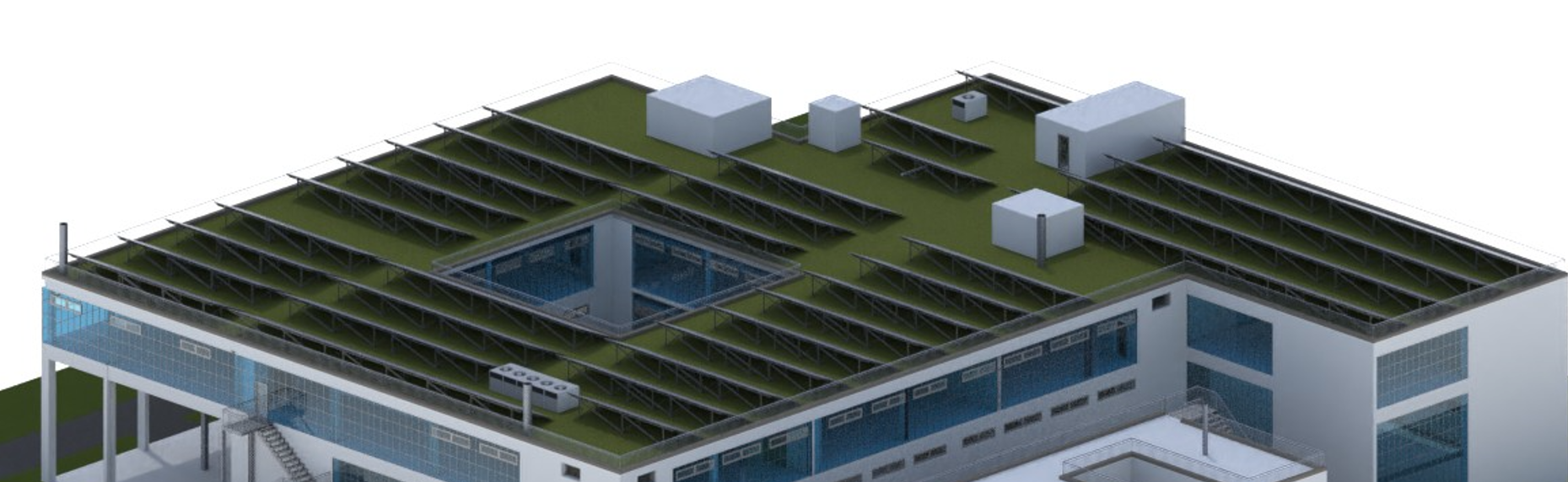
Green roof
In the design of the plants, one of the solutions envisaged by bioclimatic architecture will be implemented: the extensive green lawn on a large part of the roofs of the buildings, built in accordance with standard UNI 11235:2015; for example, at the Avezzano plant the green roof is equivalent to a soil recovery of about 1,800 m2.
The following advantages are expected:
- preservation of the roof's thermal insulation, exponentially extending its life and preserving the functionality of the waterproofing membranes;
- reduction of heat loss during the winter and generation of a thermal lag which, in summer, allows a reduction in the use of air-conditioning systems;
- reduction of fine particulate matter in the air thanks to the green mass's ability to capture particles, retaining them and then releasing them onto the substrate during rainfall, where they lose their hazardousness.
- creation of a natural habitat for insects and plants.
- significant reduction of external environmental noise thanks to the sound-insulating power of the system;
- greater psychophysical well-being, with a natural microclimate able to generate positive psychological responses;
- improved efficiency of the photovoltaic panels installed on the roof, since it reduces the emission of heat accumulated in the roof.
LEED certification of the buildings
Startengy will obtain LEED® certification for the buildings of its plants. This certification assigns a score depending on the sustainability characteristics achieved by the building in different respects.
To obtain the certification, buildings must comply with certain requirements concerning energy and water savings, the reduction of CO2emissions, indoor environmental quality, the materials and resources used, and the design and choice of the site.
The system is based on awarding "credits" for each requirement. Depending on the scores obtained in each area examined, the building reaches a given certification level (table below).
The analysis covers the whole life cycle of the building, from design to construction, and assigns a different weight to the evaluation areas.
Startengy expects its plants to obtain the "platinum" certification, the highest obtainable.